Animal Model: When Photography Looks Back
August 15, 2026
Review
Text written by Fiona van Schendel
At the 2026 Rencontres d’Arles, Animal Model: 200 Years of Photography turns one of photography’s most familiar subjects—the animal—into a surprisingly complex question: what exactly are we looking at when we photograph another species? Curated by Nathalie Herschdorfer and co-produced with Photo Elysée in Lausanne, the exhibition at La Mécanique Générale brings together more than two centuries of images, from early scientific photography and natural-history records to contemporary art, vernacular snapshots and the animal images circulating through the internet. Rather than constructing a history of animal photography, Herschdorfer constructs a history of the human gaze.
That distinction is crucial. Animals have been photographed as specimens, companions, performers, trophies, commodities, symbols and objects of desire. They have been measured and catalogued, dressed up and anthropomorphised, worshipped as embodiments of wildness and, increasingly, presented as victims of human exploitation. The exhibition’s intelligence lies in refusing to settle on a single moral position. Its six principal perspectives—the anatomical, performative, emotional, fascinated, ethical and viral gazes—show how radically the meaning of an animal image can shift according to the circumstances in which it is made and seen.
Herschdorfer thereby makes a persuasive argument: the apparently innocent animal photograph has never been innocent. It tells us how we have wanted to classify, possess and ultimately dominate the natural world.
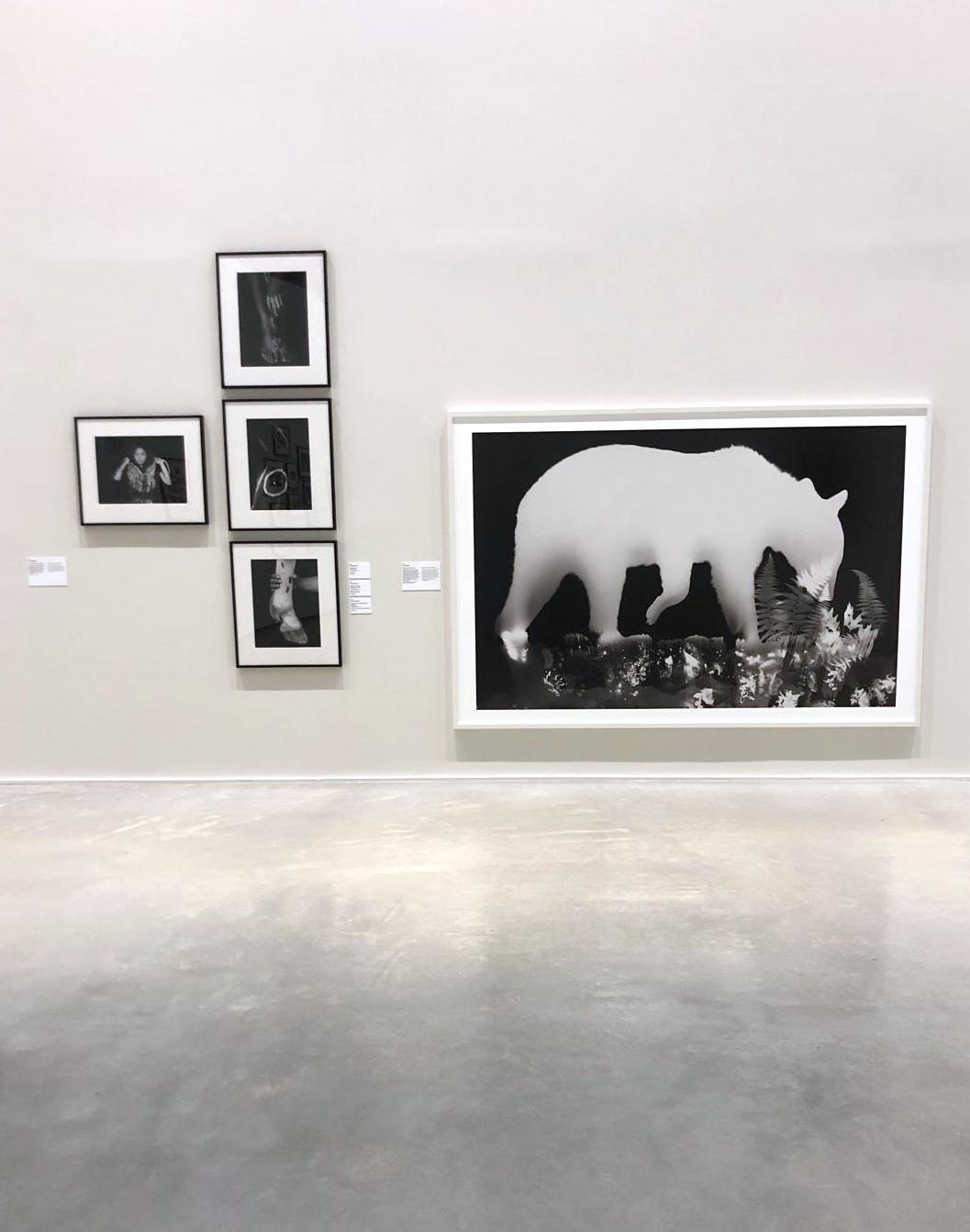
Among the contemporary artists, Zana Briski is particularly revealing because her work challenges the idea that an animal photograph must begin with the photographer’s authority. Briski’s Animalograms, made through photograms of animals encountered in the wild, are images produced not simply of animals but through their physical presence. The resulting traces are ghostly and elemental, less conventional portraits than records of an encounter.
This is an important departure from the wildlife photograph as an act of capture. Instead of demonstrating the photographer’s ability to find, approach and isolate an elusive creature, Briski allows the animal to become an active participant in the making of the image. Within Animal Model, this shift matters. It loosens photography from its traditional position of mastery and suggests a more reciprocal relationship between image-maker and subject. The animal is no longer simply something to be seen; it leaves something of itself behind.
Leila Jeffreys, by contrast, works with the almost unsettling power of the portrait. Her birds are photographed frontally, with extraordinary attention to presence, detail and individuality. A bird occupies the frame and, suddenly, the conventions of human portraiture—dignity, character, personality, gaze—seem to migrate across the species divide.
Her photographs invite the viewer to linger over feathers, eyes, posture and expression, but they also expose our tendency to read human qualities into non-human faces. The birds become individuals without necessarily becoming human. That tension is one of the exhibition’s most productive questions. Are we finally seeing the animal as itself, or are we simply becoming more sophisticated at projecting ourselves onto it?
Vincent Munier approaches the problem from the opposite direction. His animals often seem to resist the photographic encounter altogether. Working in remote environments and paying close attention to animal behaviour, seasonal changes and geographical settings, Munier constructs images in which the animal is inseparable from the landscape that shelters it.
In his photographs, the animal may be partially concealed, distant or almost absorbed into its surroundings. This is not the spectacular wildlife image that treats the animal as an isolated prize. Munier’s great subject is presence itself: the moment when a species appears briefly within an immense natural environment. His photographs preserve a sense of distance, and with it a sense of mystery. The animal is visible, but never entirely available to us.
Placed within Herschdorfer’s broader historical argument, Briski, Jeffreys and Munier form an especially revealing triangle. Briski gives the animal agency in the production of the image. Jeffreys gives it the visual status of a portrait subject. Munier gives it back its distance. Their practices differ enormously, yet all three complicate the conventional photographic impulse to possess an animal through representation.
This is where Animal Model becomes more than a survey. Its real subject is not simply the animal but the act of looking. The exhibition demonstrates that photography has never merely recorded our relationship with other species; it has actively shaped that relationship. The camera can classify and control, but it can also encounter, empathise and acknowledge difference.
That may be the exhibition’s most compelling achievement. After two hundred years of photographing animals, we might assume that photography has brought us closer to them. Animal Model proposes something more complicated: perhaps the proliferation of images has not made the animal more knowable, but has instead revealed the limits of our knowledge.
The animal remains stubbornly other.
Briski’s traces, Jeffreys’s confrontational portraits and Munier’s elusive wilderness images each arrive at that otherness by a different route. One gives the animal a physical role in the making of the photograph; another asks us to confront its individuality; the third allows it to disappear into the world beyond the frame. Together, they suggest that the most compelling animal photographs are not those that succeed in explaining or possessing their subjects, but those that allow the animal to exceed the image.
Animal Model: 200 Years of Photography is on view at La Mécanique Générale, Arles, from 6 July to 4 October 2026.