What happened to this Griffon Vulture?
October 20, 2026
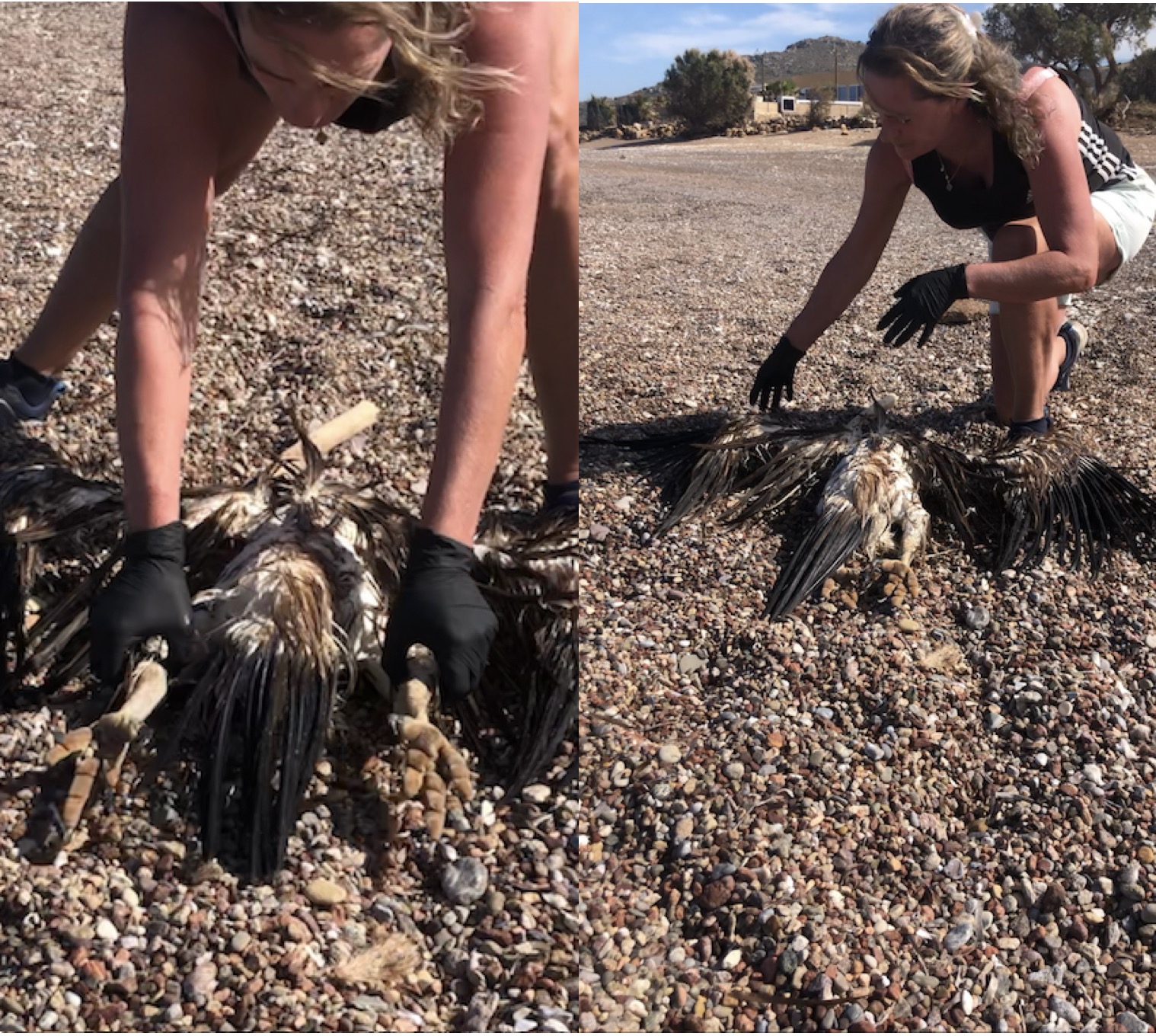
What happened to this Griffon Vulture with her nearly 2-meter wingspans ?
written by Fiona van Schendel
What happened to this Griffon Vulture with her nearly 2-meter wingspans ?
While I was walking along a calm beach in Greece, I spotted a dark shape in the surf. Intuitively I knew. It was a dead Griffon Vulture (Gyps fulvus). A magnificent bird that I have occasionally spotted in the Greek mountains for the last 20 years. With only 300 breeding pairs in Greece, they are rare.
Just very recently I was surprised to see a colony on a mountain ridge very close to the sea. Normally I only spotted them inland. This dead vulture might have been a member from that same colony as I found it along the shore. They are huge. Big birds. And the most social vultures, living together in colonies.
What killed this beautiful creature with its large wings and huge claws (that remind me of our hands and fingers by the way).
To investigate, I first went out to search for gloves as touching dead animals can be dangerous (viruses or bacteria). I decided to put it on film as it is important information for conservationists and possibly wild life crime investigators. I am posting it too not for shock value, but to show how these mountainous and unspoiled landscapes of Greece should be protected against tourism-industry (of course I’m a tourist too; we all are). Many Greek areas where these vultures survive are already designated as Natura2000 sites, yet the immediate areas adjacent to these sites, need not to be overlooked.
As I carefully examined the dead vulture, it was not wearing a tracker collar or something, so it was not monitored. I spread his primary wingfeathers, turned his heavy body. Raised his head and saw it was, with the neck coloured greenish-blue, indicating it was already decomposing.
There were further no visible, obvious external wounds.
So what caused it to die?
* Poisoned?
As there were no external wounds, it might point out that it was poisoned. These vultures are strictly scavenging birds, meaning they feed themselves on carcasses, it could happen that these carcasses are poisoned. Such as carcass of a stray dog that was poisoned (people sometimes put out food with lethal agricultural pesticides or insecticides to kill stray dogs (who often kill sheep)). Or it could be poisoned more slowly by an accumulation of eating dead farm animals that carry traces of diclofenac (anti-inflammatory) drugs.
* It ate carcasses with bullets?
The vulture could have eaten an animal shot by hunters who used lead bullets; carcasses that contain fragmented shards of these bullets, when eaten, cause a slow death. In the area local farmers shoot hare or rabbits, and if these are not picked up by the people, the hares and rabbits could be eaten by vultures.
* Another cause could be the vulture was electrocuted when touching 2 wires simultaneously when sitting on electricity power poles. Possibly.
* Another cause, is when they crash into the huge blades of wind turbines. Flying and foraging with their heads looking downward to scan for carcasses, this can happen.
* Finally, maybe old age?
I have reported the exact GPS coordinates to the wild life authorities ANIMA (the Hellenic Wild Life Case Association) and local authorities (Hellenic Coast Guard). The Hellenic Ornithological Society could be interested too.
According to the Vulture Conservation Foundation, the main causes of death for Griffon Vultures (Gyps fulvus) are largely driven by human activities, with poisoning and traumatic injuries from energy infrastructure accounting for the vast majority of case.
The Vulture Conservation Foundation has an amazing Instagram account and website on the conservation and protection of vultures and their environments. Please visit them and perhaps join one of their international meetings. @vultureconservationfoundation
ANIMA, the Hellenic Wildlife Case Association, whose main care is to rescue and rehabilitate wild animals in their natural environment. Amazing Instagram site with a myriad of wild animals and cases of rescue. @animawild
Hellenic Ornithological Society (HOS) whose mission is to protect Important Bird and Biodiversity Areas (IBAs), globally threatened species and priority habitats in Greece; to advocate sustainable development; to provide advice to government authorities; and to promote interest in the conservation of wild birds through public awareness programmes. @ornithologiki